Along the banks of the Potomac River on Ohio Drive sits a small marker to aviation history, but why is it there? How does the National Mall fit into the history of an aviation 'first'?
With the pace of today’s communications, it may be hard for modern Americans to remember how long it took for messages to be sent just a few generations ago. A reminder can be found on the National Mall in the form of the First Air Mail Marker; it commemorates the first scheduled American airmail flight on May 15, 1918, just fifteen years after the flight of the first airplane. The event in question isn’t just commemorated on the National Mall, the plaque itself also sits in the same location of where that first scheduled American air mail flight took off from on the Polo Grounds in West Potomac Park.
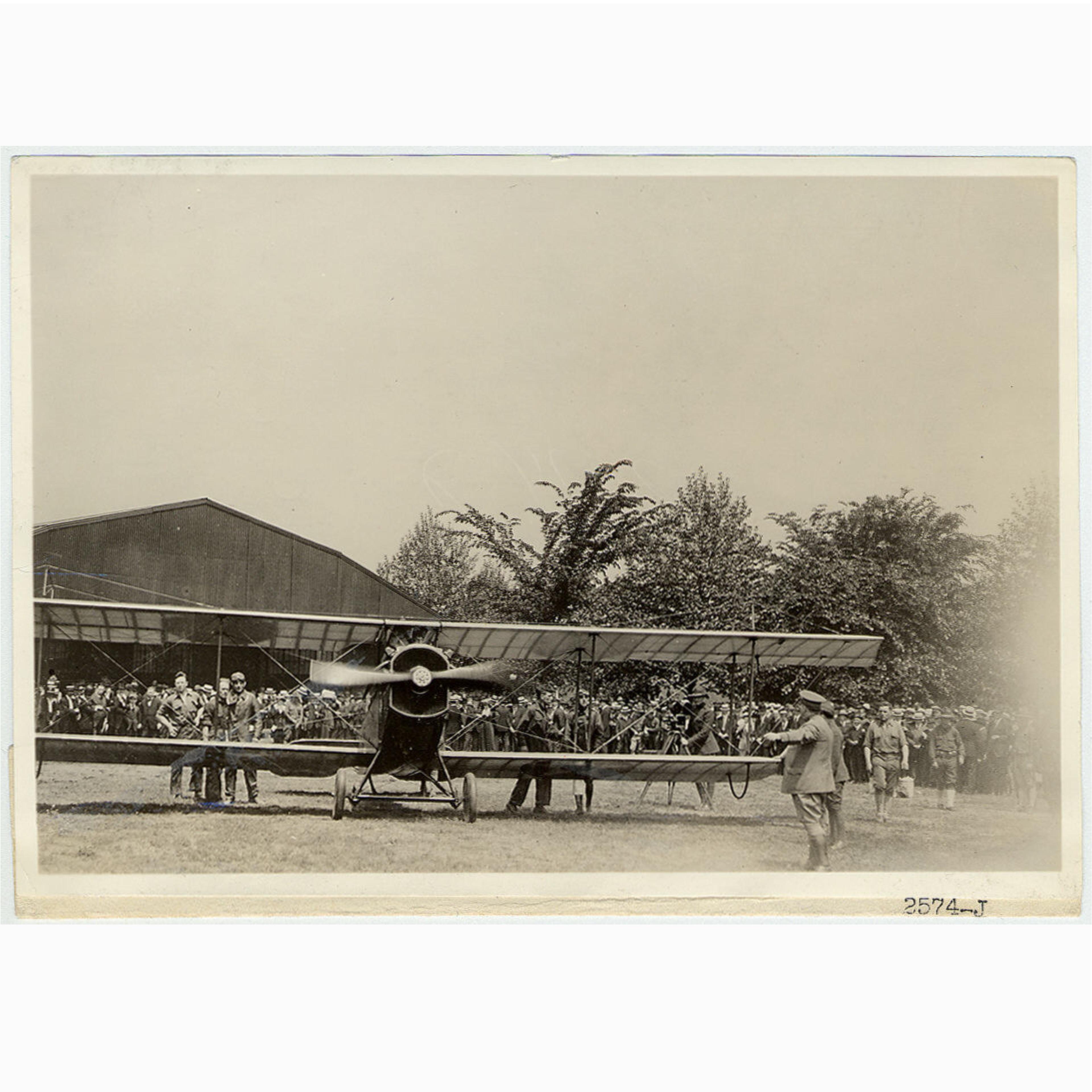
During wartime, park space has sometimes had to be sacrificed for the sake of national security. During the First World War, temporary office buildings for the military were erected across the National Mall, some of which would endure as late as 1971. In what is now the West Potomac Park Recreation Fields between the Franklin Delano Roosevelt Memorial and the Potomac River, the United States Army operated the first scheduled air mail service beginning on May 15, 1918. Given the lack of commercial airlines in the early days of aviation, the Army Signal Corps would supply the pilots and aircraft used for the air mail flights in May. The first flights would be flown in the legendary WW1 Army trainers, the Curtiss JN-4HM biplane—affectionately referred to by the public as ‘Curtiss Jennies’. Many of these planes were surplussed after WW1 and used for barnstorming and air shows, introducing many Americans to their first experiences with an airplane.
The first postal flight takeoff was witnessed by an illustrious group that included President Woodrow Wilson, his wife Edith Wilson, Postmaster General Burleson, much of Wilson’s cabinet, and many other spectators. A recent graduate from an Army flight school, Lieutenant George Boyle, was one of the six pilots to make the flight from Washington, DC to New York through Philadelphia. On the first flight, one hundred and twenty-four pounds of letters were loaded on Boyle’s Curtis Jenny. The flight took off to the cheers of the crowds, but due to navigational errors and engine trouble, was forced to make an emergency landing in a farmer’s field in Maryland nearly twenty-five miles from DC. Fortunately, the other airmail flights that day were more successful, and the service was a wild success.
The postal air mail flights would be moved to the airfield in nearby College Park, Maryland in August of 1918 when the Postal Service fully took over operations, thus ending the National Mall’s brief tenure as an airstrip. College Park Airport is now the world’s oldest continuously operating airport and the site of the Maryland-National Capital Park and Planning Commission’s College Park Aviation Museum; the museum even has its own exhibit on the Postal Service’s continuation of the airmail flights in August 1918!
On May 15, 1958—the fortieth anniversary of the Potomac Park airmail flights—the Aero Club of Washington dedicated a commemorative stone along the Potomac River, on what is today Ohio Drive, to celebrate this historic event. Joggers and other visitors pass it every day, most of them unknowing of the history that was made here.