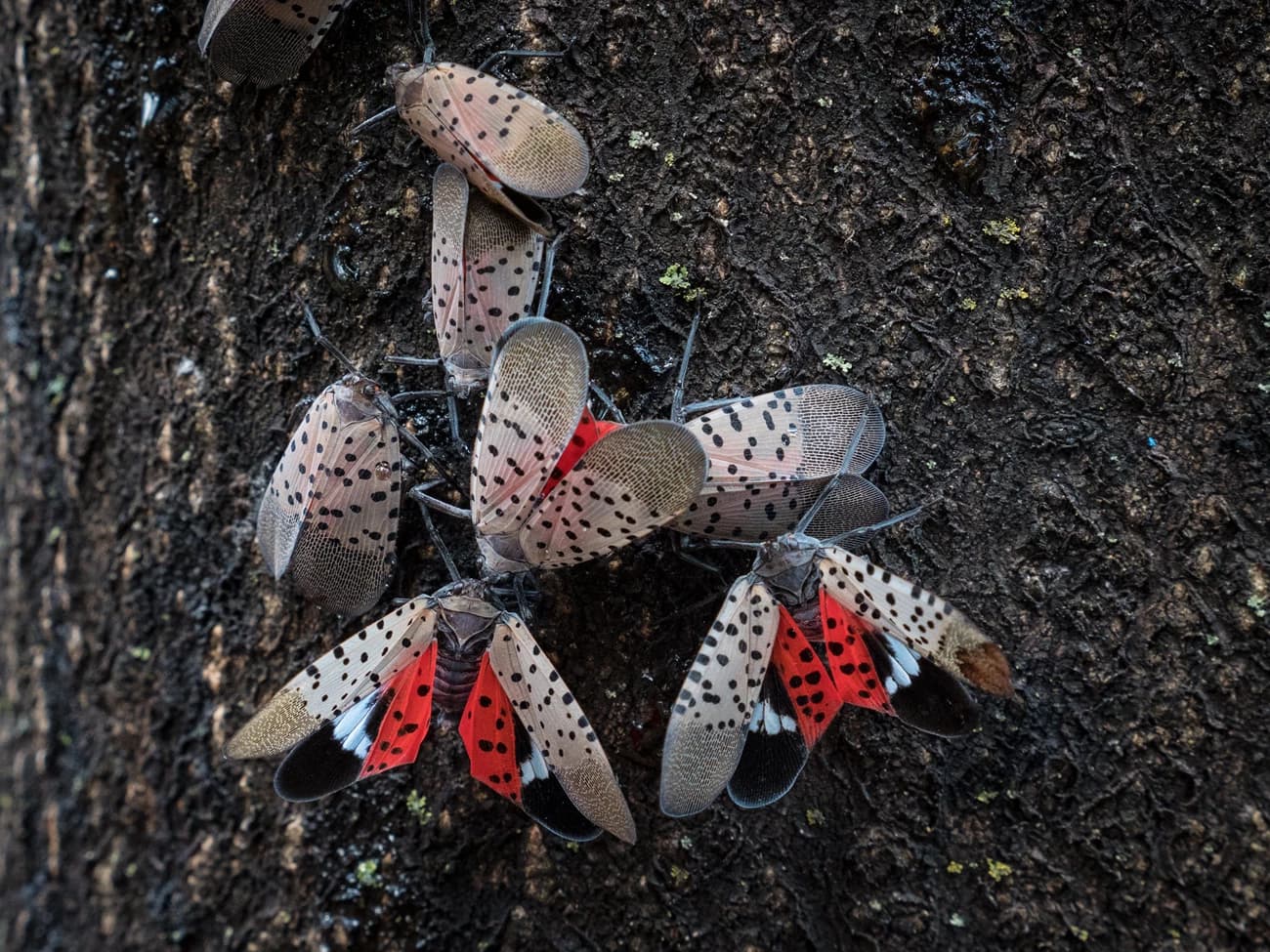
Visiting the National Mall in the summer can be both an amazing experience and one filled with inconveniences. From the scorching summer heat to the swampy humidity, the lack of shade in some areas, and the bugs and critters crawling around the park, you are constantly reminded of the fact that yes, the Mall was indeed built on a marshy swamp. One inconvenience you will likely encounter may not be familiar to you depending on where you are coming from: Lycorma delicatula, better known as the spotted lanternfly.
US Department of Agriculture, [Adult spotted lanternflies], circa 2021–2023. Reproduced from Kristin Vinduska, “On a Squishin’ Mission: The Fight Against Spotted Lanternflies,” National Park Service—Cape Cod National Seashore, May 2023, nps.gov/articles/000/on-a-squishin-mission-the-fight-against-spotted-lanternflies.htm.
Spotted lanternflies, sometimes called ‘SLF’, are beautiful creatures. Their namesake spotted wings are partially translucent, or see-through, and their crimson red hind wings make them look kind of like a bigger ladybug. They also aren’t a type of fly, despite their name! Spotted lanternflies are a planthopper, part of the Hemiptera order of insects; like their Hemiptera relatives in grasshoppers, spotted lanternflies get around primarily by hopping or flying short distances.¹ But don’t let their beauty fool you! Spotted lanternflies are now among the most invasive species in the eastern United States, and in Washington DC, they truly are everywhere.
Cornell Integrated Pest Management, Spotted Lanternfly Status Map, generated July 31, 2026. maps.cornell-ipm.org/en/spotted-lanternfly.
Originally from Southeast Asia, the first spotted lanternflies in America were found in Pennsylvania in 2014.² Since then, they have spread extremely quickly across the eastern United States as far south as Georgia. In fact, there were so many spotted lanternflies around the National Mall in the Washington DC area during the summer of 2025 that they showed up on weather radars!³
Why are they so dangerous?
In their natural habitats in Asia, spotted lanternflies often feed on the tree-of-heaven— Ailanthus altissima—which is similarly invasive in the northeastern United States. But in areas without those trees, SLFs will feed on more than seventy plant species native to the US! By making holes in and eating the sap from leaves and tree trunks, they damage many of the plants that they feed on.⁴
Colleen Witkowski, Spotted Lanternfly Life Cycle. Reproduced from Greg Ose, “Garden Foe: The Spotted Lanternfly,” Smithsonian Gardens, November 24, 2025, gardens.si.edu/learn/blog/garden-foe-the-spotted-lanternfly.
Afterwards, lanternflies also make honeydew, a type of sugary liquid almost like syrup that they leave all over the plants, which attracts more insects and leads to mold and fungal infection. The honeydew also coats the plants’ leaves, stopping them from getting enough sunlight for photosynthesis.⁵ (Some bees have even used this honeydew instead of nectar to create honey! Honey made from spotted lanternfly honeydew is reportedly darker, reddish-brown, and smoky and savory.⁶ Would you be willing to try honey made from SLF honeydew?)
I saw a spotted lanternfly—what should I do?
When you visit the Mall, you might see some locals (this author included) stomping around, kicking at the ground, and chasing bugs around to squish them. Chances are, they are hunting spotted lanternflies!
New Jersey Department of Agriculture Division of Plant Industry, [Flyer urging residents to stomp on Spotted Lanternflies], n.d., nj.gov/agriculture/divisions/pi/prog/pests-diseases/spotted-lanternfly.
In the years since SLFs have spread across the eastern United States, some natural predators have learned to target the invasive lanternflies, but they can’t do it on their own! Numerous local government offices across the area have recommended that you help stop the spread.⁷ In fact, local guidance says that you should kill them on sight!⁸ This can be done by squishing or stomping on them, spraying them with regular dish soap mixed with water, or even vacuum cleaning them.
Pennsylvania Department of Agriculture (@PAAgriculture), [Wanted poster for Spotted Lanternflies], Twitter (now X), September 17, 2021, twitter.com/PAAgriculture/status/1438854054793433090.
SLFs cannot sting or bite you either, because they do not have the body parts to do so!⁹ If you aren't a fan of squishing them, though, you can also catch them easily with just a water bottle. Holding an open water bottle above them will trick them into jumping straight in! (Watch the video below to see it in action). Putting the bottle in a freezer afterwards will kill SLFs more humanely.¹⁰ After you squish or catch a lanternfly (or another invasive species tracked by the District of Columbia, including Asian Longhorned Beetles, Spongy Moths, Emerald Ash Borers, and Beech Leaf Disease), you can choose to report it to the city’s urban forestry division!
Preventing spotted lanternflies from increasing isn’t just a summer project! During the late summer and fall, SLFs will lay egg masses—groups of dozens of eggs—on trees, walls, and other surfaces. Each egg mass can include thirty–fifty SLF eggs, part of why they have spread so quickly!¹¹
[Spotted lanternfly egg mass], circa 2021. Reproduced from Doris Behnke, “Removal of Spotted Lanternfly Egg Masses,” Agronomy News 12, no. 1 (2021), extension.umd.edu/resource/removal-spotted-lanternfly-egg-masses.
If you see an egg mass, the University of Maryland recommends the following steps to remove them:¹²
- Squirt hand sanitizer into a plastic bag.
- Arrange the opened bag just below the SLF egg mass.
- Apply a firm amount of pressure on the edge of a plastic card and scrape the card down and across the egg mass.
- Catch the eggs in the bag, then squish the hand sanitizer and eggs around in the bag.
- Seal the bag and then dispose of it. Help stop the spread of SLF!
You can and should also help stop the spread of lanternflies by checking your bags, belongings, and clothes for SLFs or eggs before you leave the Mall! Lanternflies can’t travel far on their own, so the main way that they have spread so far from Pennsylvania where they were first seen was by hitchhiking on people and vehicles!¹³
A Civic Duty
When taking a group of visitors on the National Mall for a tour recently, I was joined by a fellow historian working in the DC area. When they went off to squish an SLF that had landed a few feet from them when we were at the World War II Memorial, they described it as their civic duty to fight off this invasive pest. In the same way that Park Rangers will ask you to not step on the roots, or hang from the branches of the Mall’s cherry trees, or how the National Park Service will warn you against littering in the park, fighting off spotted lanternflies are one way we can contribute to the protection of the National Mall’s natural environment. I’m doing my part. Are you doing yours?