What do you see when you walk on the streets next to the Mall? Monuments, memorials, and statues are great symbols of important people in America’s history. But the buildings that surround you in this city also have stories to tell.
After George Washington became our first president, he made Washington DC our nation’s capital. This meant that the government needed to move into new office buildings in the city. At first, the Army and Navy used townhouses, then smaller buildings next to the White House.¹
Figure 1. Horse drawn streetcar 3 in front of War Department Building, [approx. 1870], David Sterman Photograph Collection, The People’s Archive, District of Columbia Public Library, Washington, DC. digdc.dclibrary.org/do/85f1822b-9273-4604-9754-e28d7419d817.
After many years, the Navy became so big that they needed to build a new office building that was large enough for thousands of people. During World War 1 future President Franklin Roosevelt, who was the Assistant Secretary of the Navy, wanted President Woodrow Wilson to construct this building on the Ellipse. Because Wilson thought that the wooden building would not look good so close to the White House, Roosevelt chose a spot on the Mall.²
Figure 2. Naval History and Heritage Command, NH 2502 "Main Navy" and "Munitions" Buildings, n.d. [likely 1918], www.history.navy.mil/our-collections/photography/places/washington-dc/main-navy---munitions-buildings/nh-2502--main-navy--and--munitions--buildings.html.
When these buildings were made, they were meant to only be temporary, which is why they were called ‘tempos’. The two biggest buildings were called the Main Navy Building and the Munitions Building, and both were four stories tall and built with steel and concrete. What was amazing at the time was how quickly they were built, taking less than six months to finish in 1918!³
Figure 3. John Ferrell, Construction of temporary war emergency buildings on the Mall, near 16th and 17th Streets, N.W. Piles of lumber near the Washington Monument, photograph, March 1942, Farm Security Administration—Office of War Information Photograph Collection, Prints and Photographs Division, Library of Congress, Washington, DC, www.loc.gov/pictures/item/2017764229.
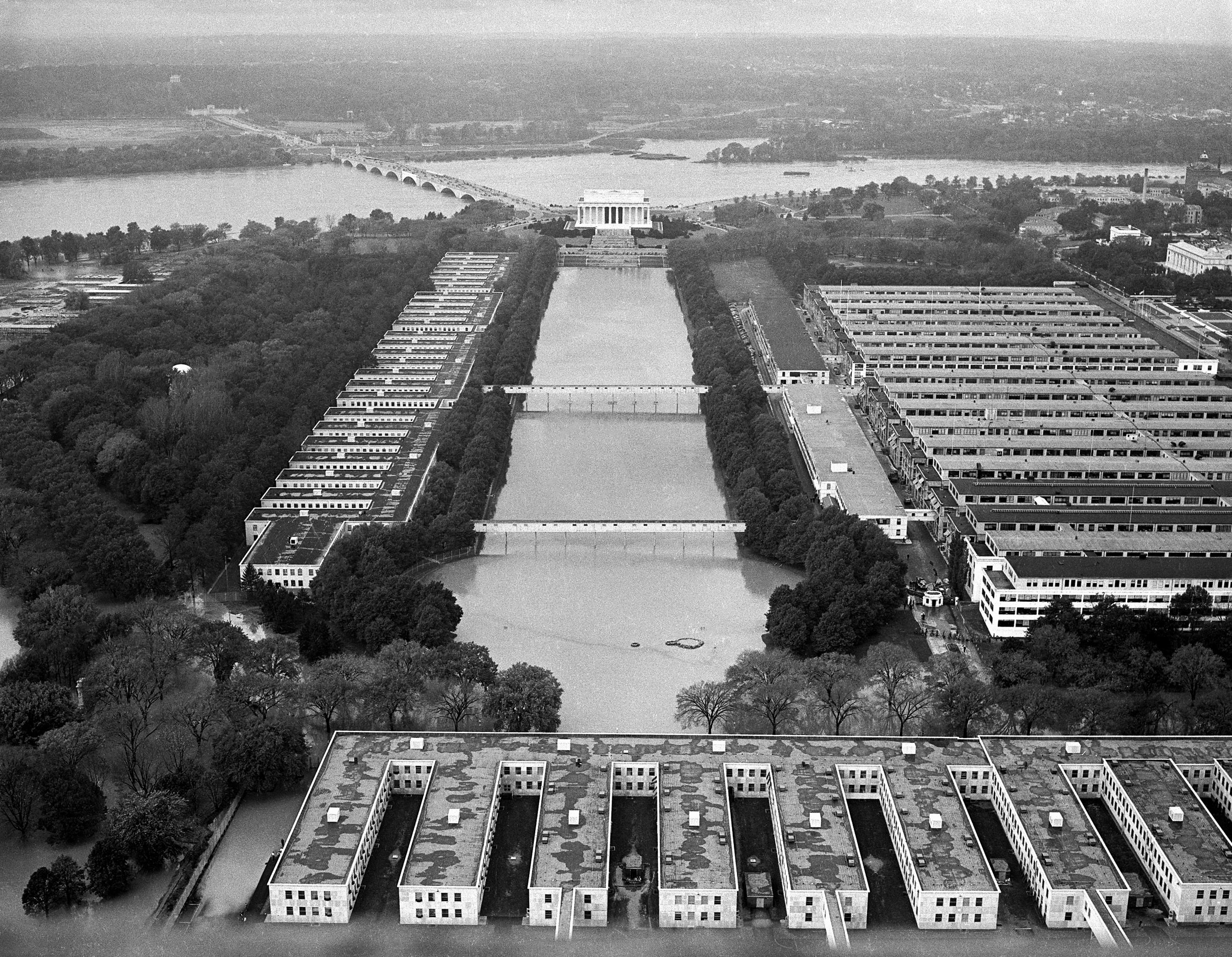
By the end of WWII, the Navy used offices in more than twenty-five buildings in the Washington area, while the Army had another seventeen buildings across the city.⁴ The war made offices in Washington so busy that even the five hundred car parking lot behind the Main Navy and Munitions was turned into more Tempo buildings!⁵ Over the course of the war, a third of the National Mall’s space was used by the military. At one point there were even bridges across the Reflecting Pool to help people get from one building to another!⁶
Figure 4. Abbie Rowe, National Park Service, Flooded National Mall, photograph, October 1942, National Capital Region Public Affairs Photo Collection, National Capital Region Museum Resource Center, Landover, MD. npgallery.nps.gov/AssetDetail/26225f76-1e97-43ec-a71f-8a2979a8bf3a.
After the war, the military had moved out of the Tempos into their new space at the Pentagon, across the Potomac River.⁷ In their place, other government agencies like the Civil Aeronautics Administration used its office spaces until the 1960s.⁸ Other parts of the government, like the National Capital Parks (who took care of the National Mall before the National Park Service today) also had their offices in Tempos!
Figure 5. National Capital Parks office in the Navy Building, February 4, 1937, Box 13, Folder 4, National Park Service, National Capital Region Photograph Collection, The People’s Archive, District of Columbia Public Library, Washington, DC. digdc.dclibrary.org/do/cbe0e989-5c13-45f6-8f1a-22bcdc7bbf14.
By the 1960s though, the ‘temporary’ nature of the buildings would mean that they would have to be replaced and taken down. President Richard Nixon (who had worked in a Tempo during WWII himself) ordered the Main Navy and Munitions Buildings to be demolished on December 9th, 1969, to make space to build Constitution Gardens.⁹
Figure 6. [Bird’s eye view of National Mall, showing the construction of Constitution Gardens on the site of the Main Navy and Munitions Building], photograph, April 8, 1975, Aerial Photography of Washington, D.C. Files, RG328 'Records of the National Capital Planning Commission', National Archives and Records Administration, College Park, MD. catalog.archives.gov/id/235195893.
The last remaining ‘tempo’ was vacated in 2025; this was the Liberty Loan Building, whose final tenant was the U.S. Department of the Treasury’s Bureau of the Fiscal Service. Built as a 'tempo’ in 1919 to house the Liberty Loans bond program during World War I on the southeastern shore of the Tidal Basin, it was originally designed with space for 1,200 federal employees. Though the General Services Administration has announced its plans to sell the building, you can still see the last standing ‘tempo’ while walking around the Mall today!¹⁰
Figure 7. National Park Service, Liberty Loan Building, 2017, www.nps.gov/articles/temporary-war-department-buildings.htm.