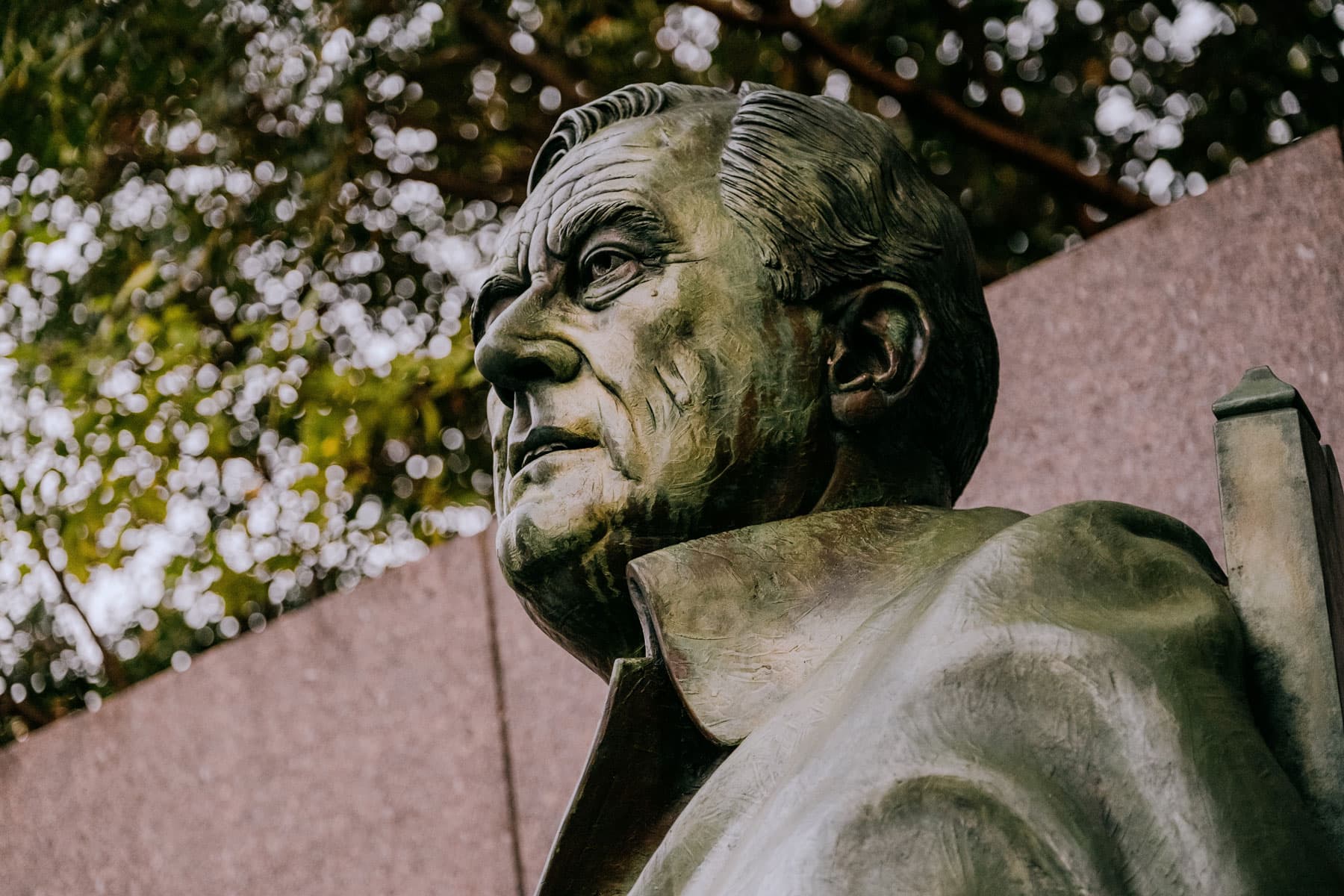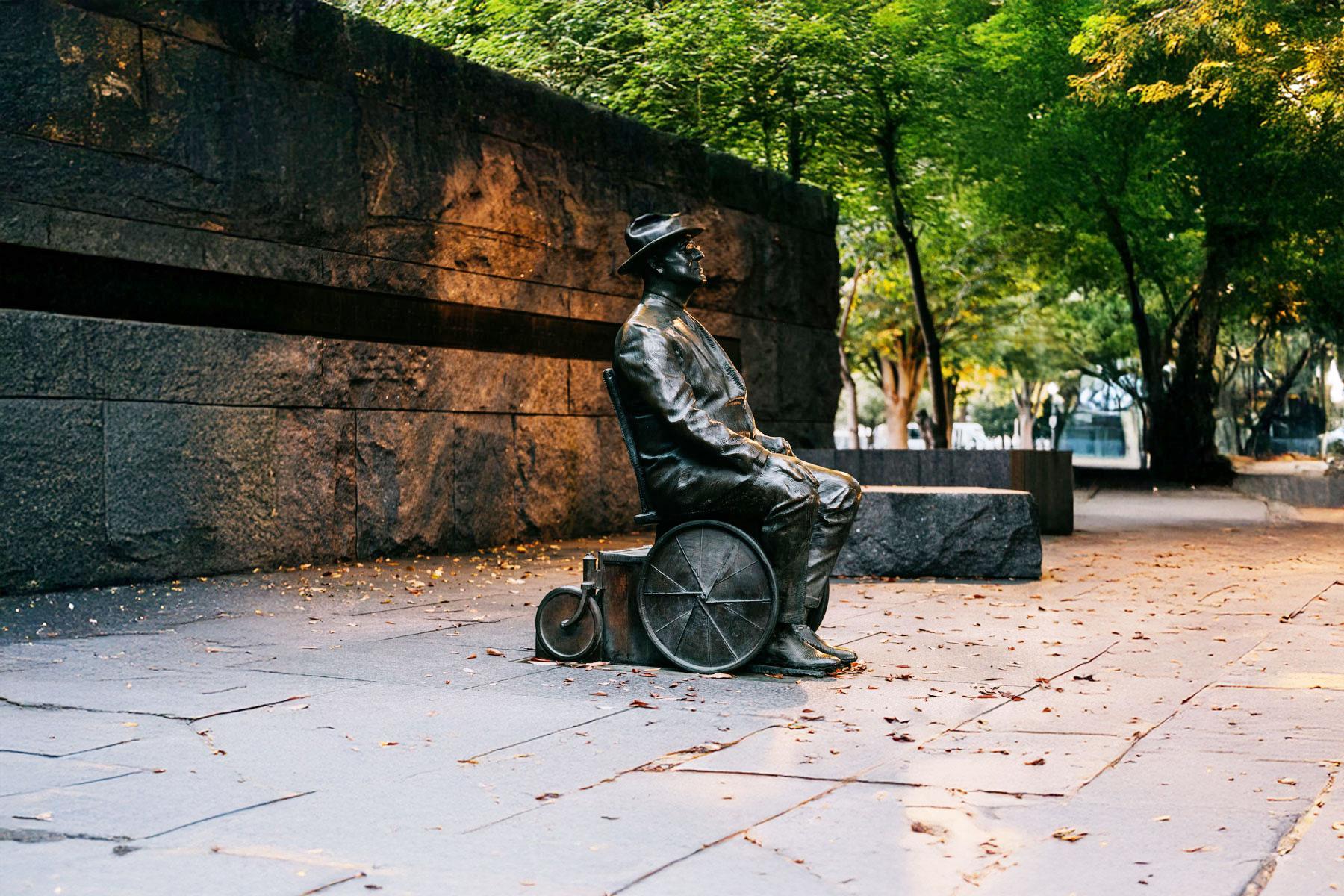
When a visitor enters the Franklin D. Roosevelt Memorial today, they are greeted by the Prologue Room and a life-sized statue of FDR using a wheelchair. Visitors entering the memorial when it opened in 1997 saw a very different view—a solitary wall. What accounts for the change is the story of FDR’s disability and an addition demanded by disability rights activists and the public.
FDR was hoping for a career in politics when he contracted polio in 1921 at age thirty-nine, leaving him unable to walk on his own. While his mother thought he should retire to his upstate New York home, FDR wanted to continue working and he realized a career in politics required people to vote for him. FDR feared that people would consider him a weak leader if they knew he could not walk unassisted. He often leaned on his grown sons or utilized braces and mobility aids to walk or held on to a podium to stand.
It was easier for FDR to keep his disability out of the spotlight as media was very different during his lifetime, and television was still in its infancy. Photographers respected FDR’s wishes that he not be photographed in his wheelchair. The FDR Presidential Library in New York claims that of all the photos of FDR taken, only four show him in his wheelchair.
Landscape architect Lawrence Halprin decided when creating this memorial that if FDR did not want to be seen photographed in his wheelchair, his memorial should not show him that way. The statue in the third term room shows FDR seated with a cape over him and his dog Fala next to him. If you look closely, you will see the casters (the small wheels on a wheelchair) on the chair, but they are easily missed. Originally, that statue was the only representation of him at the memorial. However, many people, especially members of the disability community, believed FDR should also be shown in his wheelchair, which was how he got around behind the scenes.
The National Organization on Disability (NOD) led the efforts to include FDR’s disability more prominently into the memorial’s story, believing his illness impacted his leadership. Michael Deland, who was chairman of NOD during the campaign to add the wheelchair statue said this in 1996:
“It’s a blatant historical distortion. For the forty-nine million Americans who have disabilities, there is no greater role model than FDR. It would be unconscionable if schoolchildren were to go through that memorial and not know that he led the nation from a wheelchair.”
—Michael Deland
The Memorial was dedicated under its original design on May 2, 1997. Demonstrators planned to be there at the dedication to protest for an additional statue, one that showed FDR visibly in a wheelchair. According to a letter from NOD, a week before the dedication, President Clinton requested that Senator Daniel Inouye who served as Co-chair of the FDR Memorial Commission introduce legislation for the addition of a wheelchair statue. The vote took place the night before the dedication securing the new artwork and preventing a demonstration at the dedication. President Clinton signed the legislation in July 1997.
One of the last events that President Clinton attended at the end of his administration was the dedication of the wheelchair statue on January 10, 2001. Designed by Robert Graham, this statue sits at the entrance of the Memorial. It is life-size and without any pedestal, so any visitor can get up close and sense what it was like to be near FDR as he was. In keeping with the chronology of the Memorial, this area became the Prologue Room as FDR’s illness happened before his presidency. FDR’s words are found throughout the Memorial, but in this Prologue Room, a quote from his wife Eleanor, explains how his illness impacted him and his leadership.
“Franklin's illness...gave him strength and courage he had not had before. He had to think out the fundamentals of living and learn the greatest of all lessons—infinite patience and never-ending persistence.”
—Eleanor Roosevelt