Overview
Most memorials on the National Mall are large, permanent, and made of stone or metal, towering over visitors or inviting them to step inside to honor presidents, wars, and major events. But remembrance can take many forms. The Mall’s wide, open space also welcomes temporary displays that tell powerful stories in different ways.
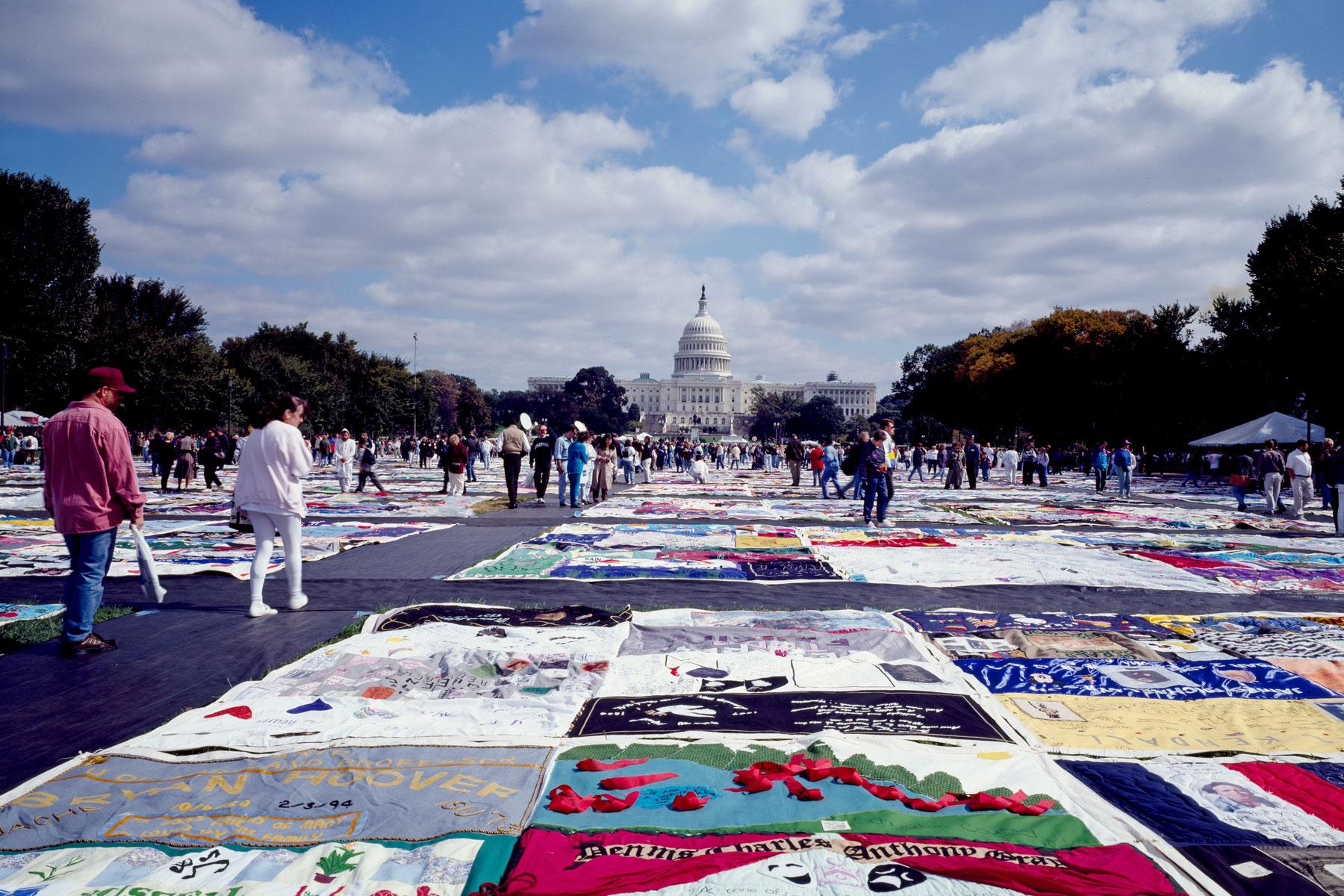
The AIDS Memorial Quilt was first displayed on the National Mall on October 11, 1987, during the National March on Washington for Lesbian and Gay Rights. The Quilt was huge – bigger than a football field – and had 1,920 panels, each one honoring someone who died from AIDS. At sunrise, six teams of eight volunteers carefully unfolded the Quilt while famous people, politicians, families, friends, and partners took turns reading the names of the 1,920 people remembered in the Quilt. This name-reading has become a tradition at almost every Quilt display. That weekend, around half a million people came to see it.
“It was like walking through a city of memories. I felt joy, sadness, and hope all at once.”
—Visitor in 1996
The massive support during the first display of the Quilt led to a national tour in the spring and summer of 1988. The tour helped raise money and spread awareness for hundreds of AIDS service groups. More than 9,000 volunteers helped carry the Quilt from city to city across the country. By the end of the tour, the Quilt had grown to over 6,000 panels, three times its original size.
By the Numbers
The Quilt started in 1987, during a time when AIDS was spreading rapidly and being largely ignored.
It was displayed on the National Mall in Washington, D.C., also in 1988 (at the Ellipse), 1989, 1992, 1996, 2012, and 2022.
Each panel is 3 feet by 6 feet, the size of a human grave.
Includes over 50,000 panels, memorializing more than 110,000 people.
The Quilt weighs about 54 tons.
It’s been displayed in all 50 states and multiple countries.
Why a Quilt?
Traditionally, quilts are made to remember, comfort, and tell stories. Families have used quilts to pass down memories, provide warmth, and celebrate milestones. Choosing a quilt was, and continues to be, a powerful way to show that those lost to AIDS were loved, missed, and worth remembering, each square telling a personal story. When seen from a distance, the Quilt appears to be a giant blanket. But as people get closer, each hand-sewn and decorated panel comes into focus.
Who made the Quilt?
Unlike the other memorials on the National Mall, the AIDS Memorial Quilt did not stem from a single artist’s vision; everyday people made it, some who had never sewn or quilted before, to express their love for someone dear to them.
Anyone could make a square to honor someone they loved. Families, friends, and even entire communities worked together. Many include names, birth dates, photos, even pieces of clothing or favorite sayings. Each one is unique, just like the person it remembers.
“He loved Madonna, loud music, and his dog. That’s what I put on his square.”
—Panel-maker
Temporary, But Impactful
When on display, the AIDS Memorial Quilt is a temporary work of art, but that doesn’t lessen its meaning and impact. Like murals and roadside memorials, temporary works can feel just as powerful as a permanent memorial because they aren’t meant to last forever. They ask the viewer to stop, look, feel, and remember.
“We made one panel for our brother. That was all we could do. But together, we made something bigger than we ever imagined.”
—Panel-maker, 1988
It has been shown in schools, churches, museums, and stadiums. It has even gone to other countries. Some people saw it indoors, hanging in halls or spread out across floors. Others saw it outdoors on lawns or sidewalks. Each setting provided people with a unique way to experience it.
Individual and Collective
Understanding the loss of hundreds of thousands of people is often challenging. The human brain can only take in so much at once, but walking through the Quilt, seeing each panel share names and stories, makes it easier to connect.
Each panel is about one person, but when they’re displayed together, the Quilt becomes the collective. It transforms overwhelming numbers into something more tangible that people can see and feel.
“Walking the Quilt made me feel like I knew these people. Like they weren’t gone, just remembered differently.”
—Visitor, 2012
Where is it now?
Today, the Quilt is cared for by the National AIDS Memorial in San Francisco. It continues to travel to schools, community centers, and public displays. In 2022, a major part of the Quilt returned to the National Mall to mark its 35th anniversary. People still create panels today.